
Tesla Model Y: Opening
To open the front trunk, ensure Model Y is in Park, and then do one of the following before pulling the hood open:
- Touch the associated Open icon on the touchscreen.
- Double-click the front trunk button on the key fob.
- Touch the front trunk button in the mobile app.
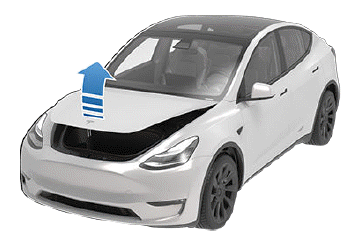
 When a door or trunk/liftgate is
open, the touchscreen displays the Door Open indicator light. The image of your
Model Y on the touchscreen also displays the open front trunk.
When a door or trunk/liftgate is
open, the touchscreen displays the Door Open indicator light. The image of your
Model Y on the touchscreen also displays the open front trunk.
WARNING: Before opening or closing the hood, it is important to check that the area around the hood is free of obstacles (people and objects). Failure to do so may result in damage or serious injury.
The cargo weight should be distributed as evenly as possible between the front and rear trunks.
CAUTION: Never load more than 110 lbs (50 kg) in the front trunk. Doing so can cause damage.
WARNING: When loading cargo, always consider the vehicle's Gross Vehicle Weight Rating (GVWR) (see Vehicle Loading). The GVWR is the maximum allowable total mass of the vehicle including all passengers, fluids, and cargo.
READ NEXT:
 Closing
The Model Y hood is not heavy enough to latch under its
own weight and applying pressure on the front edge or
center of the hood can cause damage.
To properly close the hood:
1. Lower the hood unti
Interior Emergency Release
An illuminated interior release button inside the front
trunk allows a person locked inside to get out.
Press the interior release button to open the front trunk,
then push up on the hood.
NOTE: T
SEE MORE:
Operating Navigate on Autopilot
Once enabled, the Navigate on Autopilot button appears
on the map's turn-by-turn direction list whenever a
navigation route is active and the route includes at least
one controlled-access highway. When enabled, the
Navigate on Autopilot button is blue and the turn-by-
turn direction displays the
Driving in Low Temperatures
Tire performance is reduced in low ambient
temperatures, resulting in reduced grip and an increased
susceptibility to damage from impacts. Performance
tires (summer applications) have reduced traction in
ambient temperatures below 40º F (5º C), and are not
recommended in snow/ice conditions.
